

We’ve all heard of Halloween and the scary stories surrounding this day which takes place on 31st October. Kids (and some adults!) dress-up in fancy dress costumes, go trick-or-treating, carve lanterns out of pumpkins and traditional placed them outside their front door, to ward-off evil spirits. However, Halloween derived from the Catholic celebration which honours all Saints on 1st November. The term Halloween originated from ‘All hallows eve’ which is the eve of the commemoration of all Saints. Many Italians are named after Saints and therefore this day not only honours past Saints but also family members. It’s a national holiday and all Catholics are obliged to attend Mass.
Day of the dead
The day proceeding, 2nd November, honours the family members who have passed away. In Italy, the dead are remembered and their life celebrated. In general it is not thought of as a sad, somber day but a day to give thanks and prayers for those who have gone before us.
The ‘day of the dead’ or ‘Commemorazione dei defunti’ as it is known in Italian is a sacred day and after Mass almost everyone visits their beloved ones who have been laid to rest in the local cemetery. Flowers and prayers are given to immediate past family members and then the traditional ‘passeggiata’ proceeds; a walk around the cemetery, visiting past friends and chatting to other friends whom are also there paying their respect. Italians are very social people and like nothing more than being amongst friends, family, chatting/gossiping and of course eating!
I have always been curious about Italian cemeteries but I have never had the courage to enter without due cause. I’ve always felt like I’d be intruding, being disrespectful in some way, therefore I’ve never stepped foot into my local cemetery which I have passed daily for the past 7 years. However, upon deciding to write this blog, a dear friend of mine, Maria, said that she would be pleased to show me around our local cemetery.
Guided tour of the local cemetery
Originally from San Vito Dei Normanni, she moved to the United States when she was a little girl and lived there most of her life. But the allure of grand children drew her back to Italy. She gave me the most interesting and intriguing tour of the various sections of the cemetery which is a labyrinth, and unusual mix of old, new, rich and poor tombs. Ranging from what we British people would consider ‘traditional’ grave stones, to luxury mausoleums where many families are buried and ‘place holders’ have already been prepared for future family members to reside.
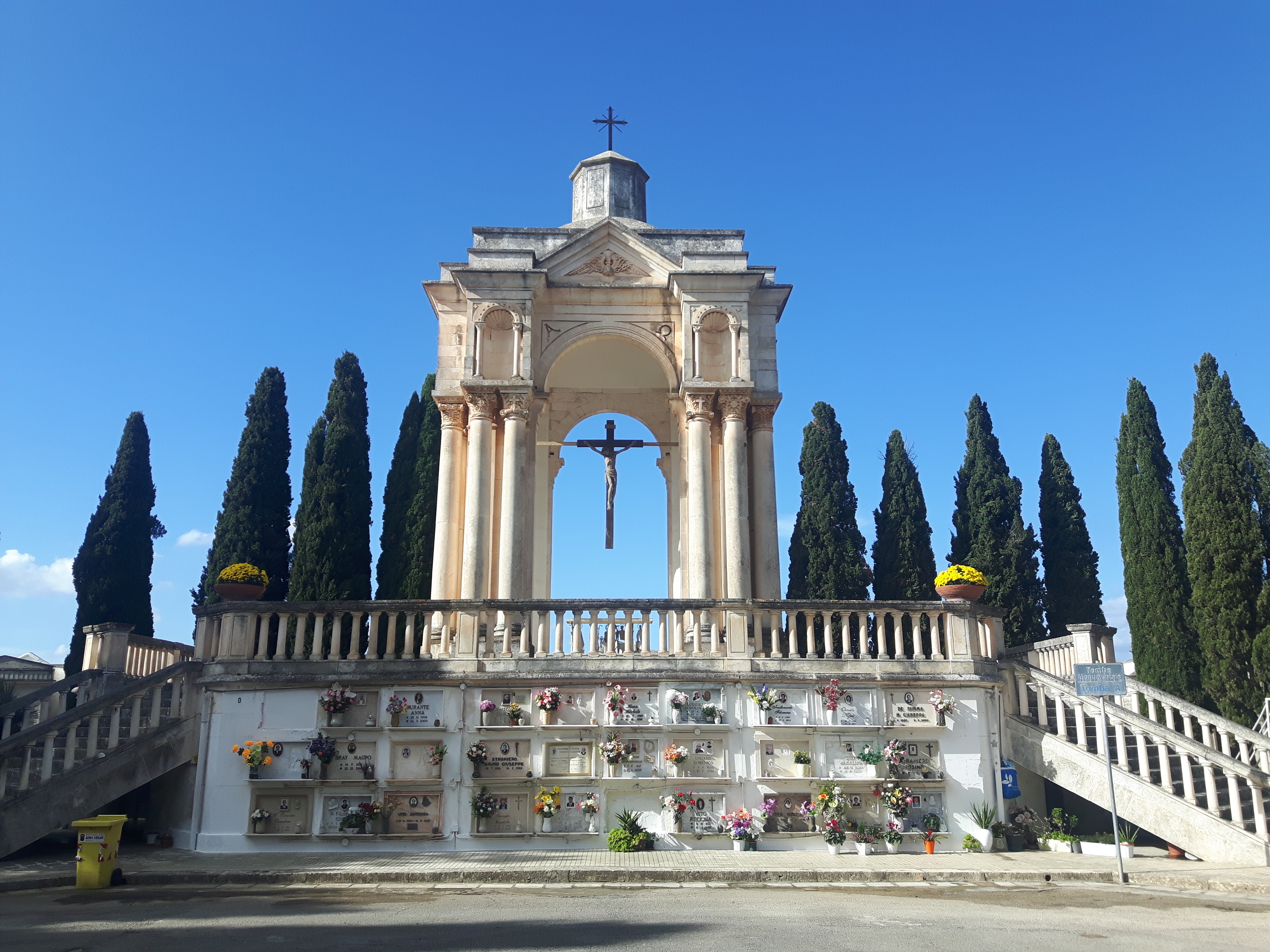
The cemetery grounds are kept pristine; gardens neatly trimmed and tended to and there was an air of tranquillity and calmness; I didn’t feel at all unwelcome by the locals who were in there paying their respects, in fact we bumped into some friends and stopped for a quick chat.
You could see that most of the graves are visited regularly; fresh flowers laid and their mausoleums cleaned and cared for. Unfortunately, there were a few mausoleums that were no longer attended, perhaps because their family had moved away and some, but not many underground mausoleums were in disrepair, mouldy and unloved. However, by sharp contrast, there were many gleaming, grand structures, with small artifacts/memorabilia enclosed in the cribs, many contained pictures of the deceased and of course fresh flowers.


Maria took me to her family’s mausoleum, which was very impressive, dating back to the 1920’s where her great-grandparents, grandparents and other family members were laid to rest. It is one of the few mausoleums that is consecrated, so it’s possible to hold a service within the large structure. She casually told me “this will be my resting place”, which made me wonder where my final resting place would be. I have no family here, no pre-prepared mausoleum or anyone to arrange my funeral. What a sad and humbling thought.
Maria’s family mausoleum was located next to one of the many churches within the grounds where some of the oldest bones are laid to rest. The oldest I found dated back to 1866 and Maria informed me that the first person to be buried in the ‘new’ cemetery was a widower aged 78 on 4th May 1841. The cemetery opened up for ‘business’ on 1st May 1841 and has expanded over the generations (naturally!). Previously people were laid to rest in the crypts, in the churches they attended.


What’s the process when someone dies?
When a person dies, they are embalmed, returned to the family home for people to pay their last respects and buried within 24 hours. A service is given at a local church and then they are laid to rest in the family mausoleum for 7-10 years. After which, their casket is opened, and if sufficiently decayed, their bones removed and transferred into a small ‘bone’s box’ and laid to rest again in a smaller ‘porthole’. If they’re not decayed enough, they are resealed and laid to rest for another 3-5 years, then the process is repeated. Each time a small service is held for the family. If the mausoleum allows it, certain family members will remain where they were originally laid to rest. Usually the patriarch or original owner of the mausoleum and closest relatives. People who don’t have a family mausoleum are laid to rest in the grounds of the cemetery and a simple headstone is placed above their grave.
So, this Halloween don’t just think of the traditional ghosts and ghouls, take a moment to remember your loved ones who have passed before us.
Happy All Hallows Eve!


 Puglian Pleasures
Leave a comment